













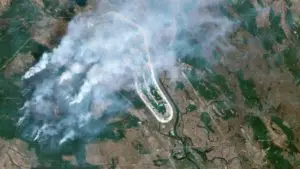
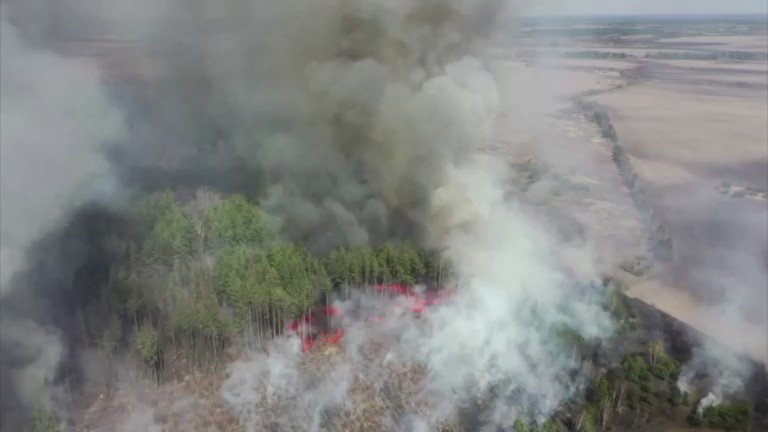
As if that weren’t enough, whilst a pandemic is ravaging the planet, a massive fire is now sweeping through the Chernobyl exclusion zone. The images look like something out of a disaster film. Thick plumes of smoke and sprawling flames have filled the sky around the Ukrainian power station in recent days – the site of the worst nuclear accident in history in 1986. More than 20,000 hectares have gone up in smoke since the fires began on 4 April. On Monday 13 April, the fire was just a few hundred metres from the Chernobyl nuclear power station. Kyiv, for its part, insists that the situation is under control and that radioactivity levels are within normal limits. LCI provides an update on the situation.
How did the fire start?
According to the local police, the fire was started by a young man living near the Chernobyl area, who faces up to five years in prison for “destruction of vegetation”. The 27-year-old man admitted to setting fire to the grass “for fun”. The fire started in the heavily contaminated Polesskoye area, situated around 50 kilometres west of the power station. Since 4 April, when the fire broke out in this highly radioactive area, more than 400 firefighters and rescue workers, three aeroplanes and three water-bombing helicopters have been mobilised to fight the forest fire, which has been fuelled by the wind and an unusual drought over the last few days.
How is he getting on after 12 days?
NASA satellite images updated on 14 April suggest that the fires are now just a few hundred metres from the Chernobyl nuclear power station. According to Sergiy Zibtsev, director of the Regional Fire Monitoring Centre for Eastern Europe, based in Kyiv and linked to a United Nations programme, the situation remains unpredictable even today. “In the western part of the exclusion zone, it has already covered 20,000 hectares,” he told AFP on Monday.
Yaroslav Iemelianenko, director of an organisation that runs guided tours of the exclusion zone, said on Facebook that the fire had reached the ghost town of Pripyat, which was evacuated following the 1986 disaster. According to the country’s authorities, the fire is now under control. On Monday, nearly 540 tonnes of water had been poured over the area. “There are no longer any open fires,” the Emergency Situations Service stated in a press release on Tuesday 14 April, reporting “isolated pockets” of “smouldering fires”. It will take several more days to extinguish them.Reuters✔@Reuters
A forest fire near the abandoned Chernobyl nuclear power station has been extinguished, according to Ukrainian officials https://reut.rs/2wAYsqv
335Twitter Ads information and privacy206 people are talking about this
Are the facilities under threat?
According to the NGO Greenpeace, this is the worst fire ever recorded in the Chernobyl exclusion zone, which covers a 30-kilometre radius around the former power station. Citing satellite images, the environmental organisation stated on Monday that the fire was only “around 1.5 kilometres” from the sarcophagus covering the reactor that exploded accidentally in April 1986.
"The Chernobyl nuclear power station, the radioactive waste storage sites and other critical infrastructure within the exclusion zone are not under threat,” Volodymyr Demtchouk, a senior official with the Ukrainian emergency services, sought to reassure the public in a video posted on Facebook the same day. He added that the firefighters’ main task was to locate the areas affected by the fire and prevent it from spreading. “According to the Ukrainian authorities, the fire is reportedly under control. Well done to the firefighters and everyone who came together to put out this fire,” the NGO tweeted on Wednesday.Greenpeace France✔@greenpeacefrReplying to @greenpeacefr
This is the worst fire ever recorded in the exclusion zone of #Chernobyl, which covers a 30-kilometre radius around the former power station. The fire is only about 1.5 kilometres from the containment structure covering the reactor that exploded in April 1986. #Greenpeacehttps://twitter.com/greenpeaceru/status/1249630206366752775 …Greenpeace Russia✔@greenpeaceruWildfires near the Chernobyl nuclear power station, which have been burning since 3 April, have already become the largest in the entire history of this exclusion zone. These fires are extremely dangerous because radionuclides in the upper soil layers could be released into the air.69Twitter Ads information and privacy130 people are talking about this
What about the level of radioactivity?
The Ukrainian authorities are seeking to reassure the public and have stated that the fire has not caused any increase in radiation levels. However, after the fire broke out, the acting head of the government’s environmental inspectorate, Iegor Firsov, had stated that radiation levels at the epicentre of the fire were well above normal. His message was accompanied by a video showing a Geiger counter registering a level of radioactivity 16 times higher than normal. He later retracted his comments.
Having come under criticism in recent days for his inaction in the face of a disaster of unprecedented scale, Ukrainian President Volodymyr Zelensky finally announced late on Monday evening that he was monitoring the situation closely. “The public has the right to know the truth and to feel safe,” he emphasised, as rumours of rising radioactivity and risks to the power station were circulating on social media. However, despite these promises of transparency, the authorities have for several days now stopped publishing their estimates on the spread of the blaze.
This is set to fuel the panic on social media even further, whilst the spectre of the 1986 disaster still looms large. “It’s terrifying to see that television and radio are remaining silent on this issue. It’s appalling. Russia and Ukraine are still keeping quiet about their problems, and people end up thinking there’s no problem at all. Irresponsible people, irresponsible leaders – this is the beginning of the end…”, tweeted a young Ukrainian woman on Monday 13 April, reacting to a post by Greenpeace Russia.Eve@Jenny_rusReplying to @greenpeaceru
It is also frightening that there is no mention of this on TV or the radio. This is terrible. Russia and Ukraine are still keeping quiet about their problems, and people still believe that there are no problems. Irresponsible people, irresponsible leaders – this is the beginning of the end...16Twitter Ads information and privacySee Eve's other tweets
Could the cloud reach as far as France?
To verify this, the National Institute for Nuclear Safety (INSN) carried out a modelling exercise to estimate the radioactivity released by the fires. “These simulations indicate that air masses originating from the area affected by the fires on 5 and 6 April may have reached France from the evening of 7 April 2020. As of 14 April 2020, these air masses were still covering half the country. The levels of radioactivity expected in France are extremely low,” the institute states.
The releases that occurred between 9 and 11 April 2020 are the most significant according to the modelling, notes the National Institute for Nuclear Safety in its press release. “The weather conditions that prevailed up until 14 April facilitated the movement of air masses from the area where these releases occurred towards Belarus, southern Ukraine, eastern Romania and eastern Bulgaria. They have not reached France to date,” the public body states.