













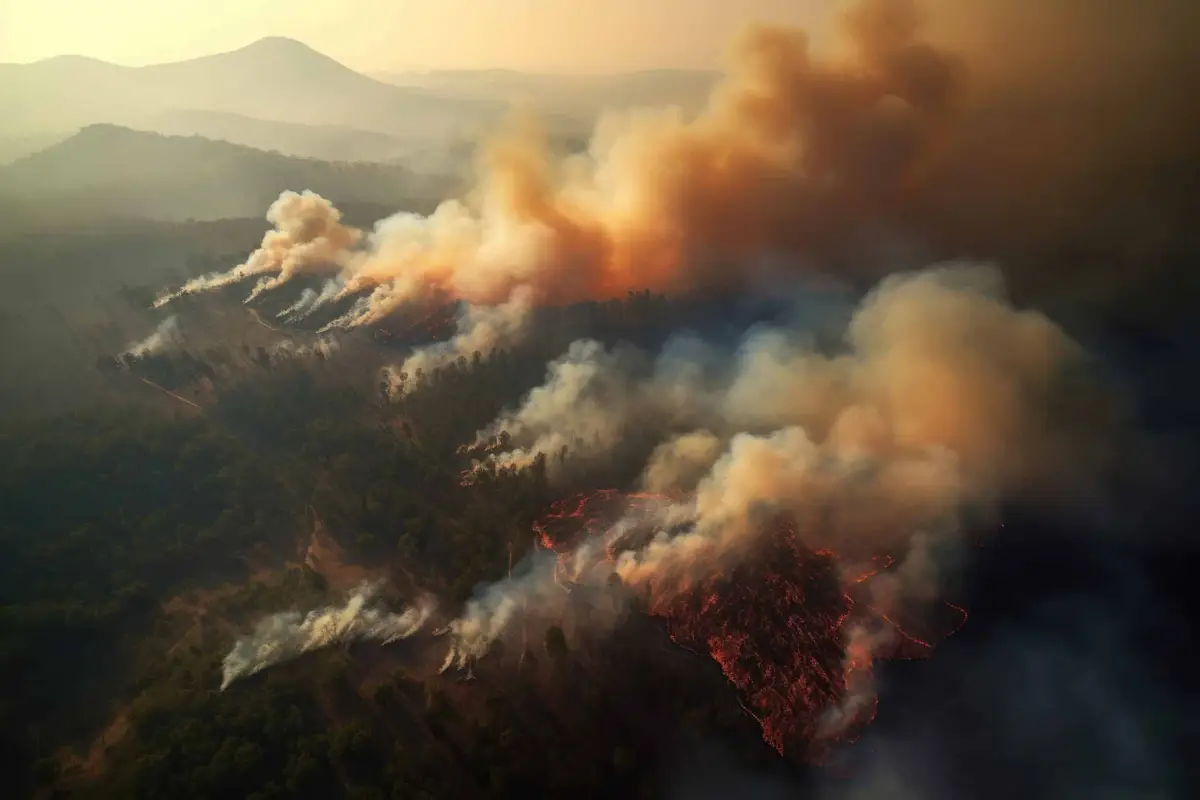

Forest fires are raging in Quebec, with 1.5 million hectares of land burnt. The record-breaking fire, located 1,300 kilometres north of Montreal, is mercilessly devouring the dry moss under a sky devoid of clouds but filled with smoke. This disaster accounts for a significant proportion of the 9.9 million hectares of woodland and grassland already reduced to ashes in Canada. Since the start of the year, the flames have engulfed an area equivalent to the size of Portugal. Sadly, on Thursday 13 July, a female firefighter lost her life whilst on duty in the west of the country.
This fire season has been described by the Canadian government as “the worst on record”, and yet it is only halfway through. The Canadian Interagency Forest Fire Centre (CIFFC), responsible for coordinating firefighters nationwide, reports that of the 3,989 fires recorded since January, 901 are still active. Marieke de Roos, communications officer at the ISCFC, comments: “At the moment, this is fewer than in 1989, a landmark year in which 12,204 fires were recorded. However, the fires of 2023 are consuming much larger areas.” A study by the Centre, covering the last four decades, confirms this nationwide trend: the number of forest fires is falling, but their intensity is increasing.
🇨🇦🤝🇫🇷 In #Canada, which continues to face violent #ForestFires, the fire and rescue services are continuing to work alongside their Quebec counterparts:
🚁Reconnaissance operations
🔥Detecting hotspots using drones
👨🚒Edge treatment pic.twitter.com/xQz70Q6SjV— Civil Protection (@SecCivileFrance) 16 July 2023
The vast plains of Alberta, in the central-western part of the country, are no strangers to wildfires, but the blazes have already affected eight times the five-year average in terms of hectares. Although the June rains have brought most of the fires under control following a particularly severe May, firefighters remain on alert. Josée St-Onge, spokesperson for the Alberta Forest Fire Service, warns: “We still have several weeks of hot weather ahead of us and the North-West is already getting hotter.” The situation is similar in the Yukon, the Canadian region bordering Alaska, which has been relatively spared by the fires so far.
In Quebec, more than 1,000 firefighters are battling blazes that pose a direct threat to towns and villages. Due to the growing number of fires, they are focusing on the most spectacular ones, leaving several kilometres of forest to burn further north. “The priority is to extinguish fires near communities and industrial sites,” emphasises Ms St-Onge. The strategy adopted by the firefighters, known as “sustained action”, is now the federal standard: the aim is no longer to extinguish the fires, but to contain them as much as possible.