













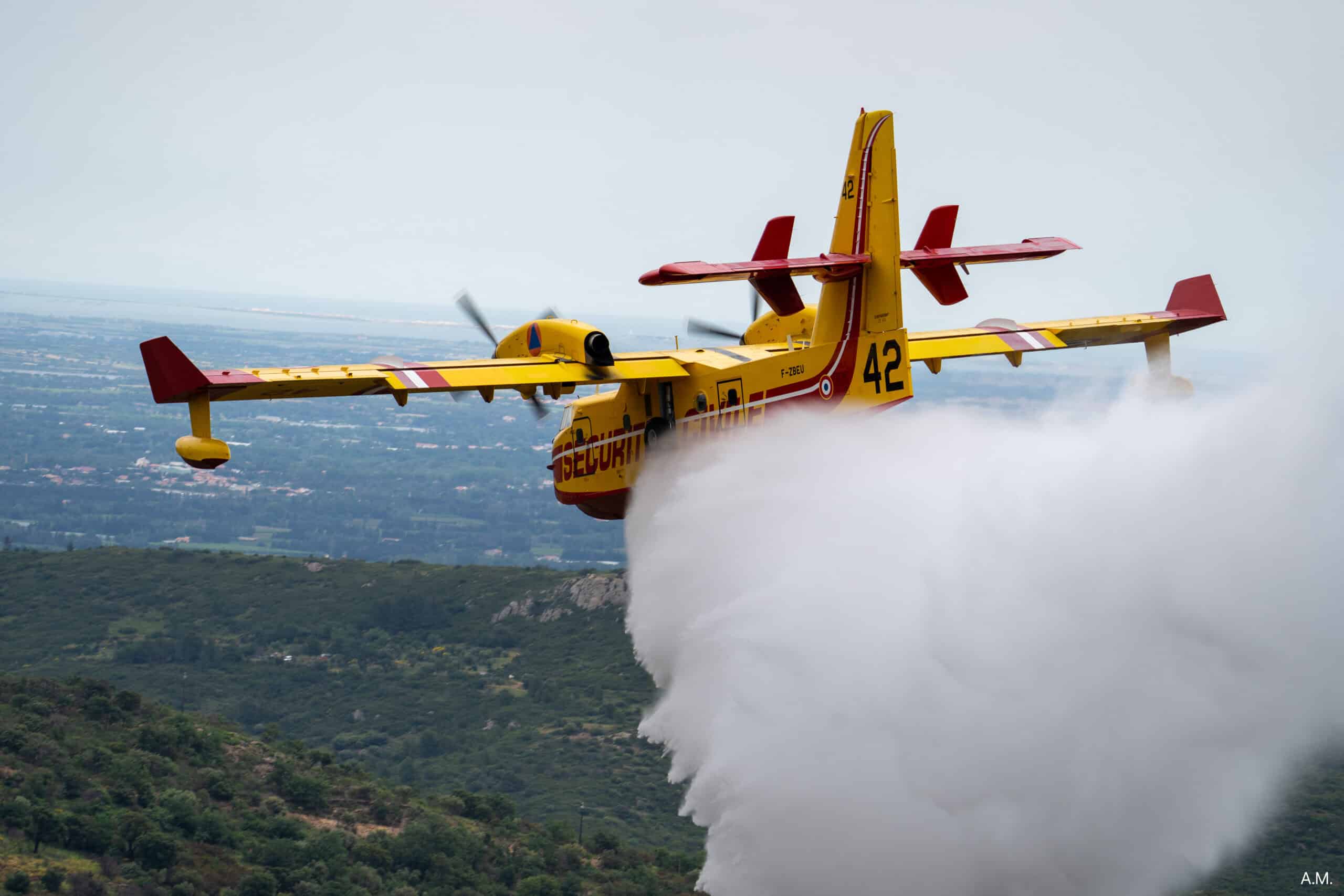

The French fleet now comprises just 12 Canadair aircraft, of which only 5 or 6 are actually operational during peak season, with an average age of 30 years and a chronic shortage of spare parts. Last May, an aircraft damaged in Corsica further exacerbated the strain on a fleet that was already too small to cover the whole of the country.
These aircraft, which are ‘put under severe strain’, are exposed to highly corrosive seawater 90 per cent of the time, which further extends maintenance cycles. The result: at the slightest sign of dual deployment – as in 2025 in the Hérault and then in the hills above Marseille – the command staff struggle to maintain an adequate level of aerial response.
An ageing fleet under strain
The principle of ‘early fire suppression’, the cornerstone of French doctrine, requires intervention within the very first few minutes to prevent the fire from spreading out of control. However, the expansion of areas classified as ‘very high risk’ by Météo-France makes this early intervention increasingly difficult, despite the pre-positioning of ground-based equipment and the deployment of Dash or Canadair aircraft on ‘armed aerial surveillance’ missions.
Sabena Technics’ technicians are performing one miracle after another to keep the aircraft operational, but the lack of an active production line since 2015 limits access to new parts. In the summer of 2024, seven water-bombers were simultaneously out of action; only favourable weather conditions averted an operational disaster.
Replacements still a long way off
To ease the strain on the fleet, Paris has ordered two DHC-515s via the European RescEU mechanism; however, their delivery is not expected until 2028, a timeline deemed optimistic by several elected representatives and experts. These aircraft will feature autopilot and modern relief systems, but they will remain a minority within an ageing fleet.
In the meantime, chartering private aircraft and the ad hoc activation of European support are temporary and costly solutions. The need for a sovereign industrial response is therefore pressing.
The appeal of a 100 per cent French seaplane
This is the very aim of the F-100 Frégate project led by the Bordeaux-based start-up Hynaero: an amphibious seaplane offering 70 per cent more water capacity and modern flight controls. Two prototypes are planned for 2029, with entry into service targeted for 2031, thanks to a partnership signed with Airbus Defence & Space, Safran and Thales.
The programme, estimated at €1 billion, has already secured financial backing from the Sud Region and France 2030, as well as 27 letters of intent – including one from the French Civil Protection Agency. The aim is to guarantee a ‘made in France’ solution in the face of rising climate-related risks.
Other options: a converted ATR and an A400M firefighting aircraft
Meanwhile, Positive Aviation is working on the conversion of an ATR 72 fitted with floats, which was unveiled at the last Paris Air Show. Airbus, for its part, has tested a ‘firefighting’ version of its A400M military aircraft in Nîmes, capable of dropping 20 tonnes of fire retardant and operating at night – a key selling point for local councils seeking rapid solutions.
Ultimately, France could therefore rely on a mix of aircraft – the DHC-515, the F-100 Frégate, the amphibious ATR and the A400M – to rebuild a resilient fleet. But before we see these new additions on the tarmac at Nîmes, public vigilance remains the first line of defence: check our real-time fire tracking map, the fire risk map and the forest weather forecast before undertaking any outdoor activities in natural surroundings.