













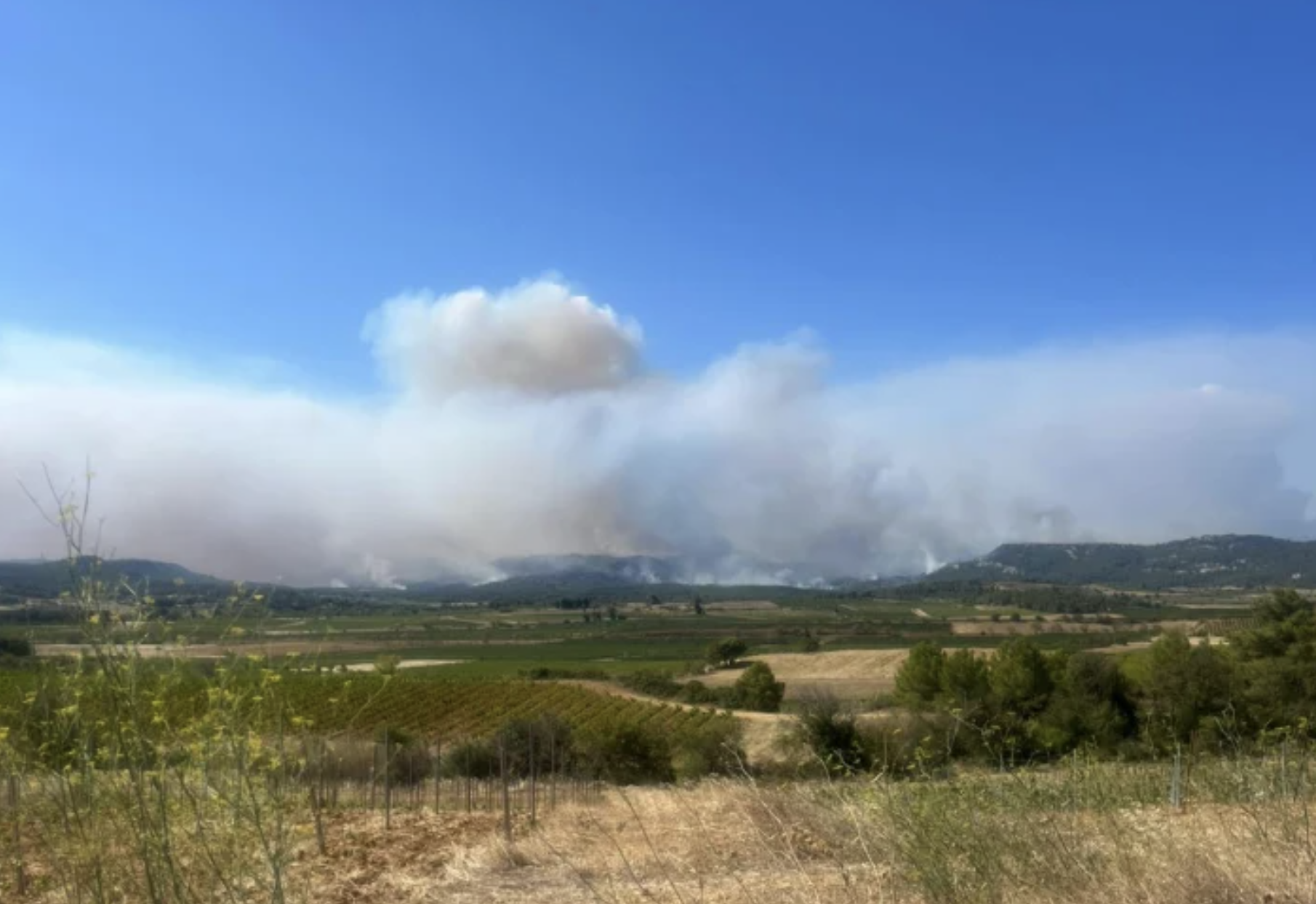

Since Tuesday, a fire of exceptional intensity has been ravaging the Corbières mountain range in the Aude department. It is the largest fire of summer 2025 in France, spreading at breakneck speed with a plume of smoke visible as far away as Spain. Whilst many media outlets are focusing on the tragic toll – hectares of land devastated, homes destroyed and casualties – it is important to put this into perspective by highlighting the heroic efforts of the fire service. Thanks to the ‘Defence of Sensitive Sites’ (DPS) strategy, designed to protect threatened areas, thousands of homes and hundreds of critical sites (residences, key infrastructure, telecoms relays, etc.) were saved from the flames. This article, written in an expert yet accessible style, provides an overview of the situation: the toll, the resources deployed, the meteorological factors at play and first-hand accounts from the field.
> Follow the live coverage
A historic disaster: loss of life and damage to property
The fire broke out suddenly on Tuesday 5 August, at around 4 pm, near Ribaute, and spread at an astonishing speed of around 6 km/h, fuelled by strong winds and very dry vegetation. In less than 12 hours, the fire had spread across more than 10,000 hectares, reaching 13,000 hectares on Wednesday morning according to the Aude Fire and Rescue Service (SDIS), and even 15,000 hectares by midday. By way of comparison, this is equivalent to the total area burnt in France throughout 2024, and more than double that of 2023. Fifteen municipalities in the Corbières mountain range were affected by the fire, making it one of the largest forest fires in France in recent decades.
The death toll is high. One person – a 65-year-old woman who refused to evacuate – lost her life in Saint-Laurent-de-la-Cabrerisse. Nine people have also been injured (including several firefighters) and one person is missing. In terms of damage, at least eight houses have been burnt to the ground in various villages, notably in Saint-Laurent-de-la-Cabrerisse, where the fire swept through the village, leaving a trail of devastation in its wake. According to preliminary figures, a total of 25 homes were affected by the flames (some partially damaged), along with around thirty burnt-out vehicles. Entire campsites and several hamlets had to be evacuated as a matter of urgency, and around 2,500 households were left without electricity. In areas not subject to evacuation, residents were urged to stay indoors to avoid putting themselves at risk.
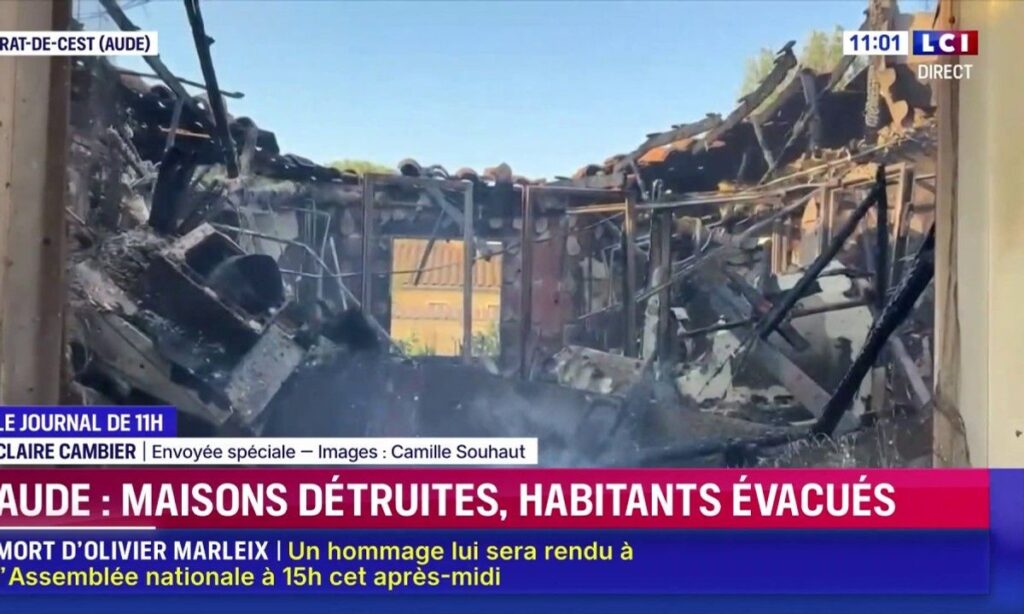
The intensity of this ‘mega-fire’ took many residents by surprise. “ It all happened so quickly (...) The fire came from the other side; it engulfed the whole hill ”, says Jean-Loïc, a resident of Saint-Laurent-de-la-Cabrerisse. The homeowner tried desperately to protect his house – where he had lived for 24 years – using nothing but a garden hose, before being forced to flee. When he returned, he found his home completely burnt down. “I haven’t got a penny, I’ve got nothing, everything’s gone up in smoke” ”, he laments, still in shock. His account illustrates the unprecedented violence of this disaster, described as “a real furnace” by the emergency services, as well as the plight of those affected.
Thousands of homes saved thanks to the protection of critical infrastructure (DPS)
Faced with such a devastating fire, the work of the firefighters helped to prevent an even worse disaster. From the very outset, the firefighters deployed the ‘Defence of Sensitive Points’ (DPS) strategy, which involves actively protecting homes, strategic buildings and infrastructure threatened by the advancing flames. In practice, teams take up positions around villages, hamlets and high-risk sites to attack the fire, create buffer zones and halt its progress as it approaches inhabited areas. This tried-and-tested tactic has proved spectacularly successful in the Aude, although the fire continues to pose a challenge to the firefighters.
🔥#Fire in the Aude.
Beyond the horrific toll, it is important to remember that countless lives, homes and infrastructure have been saved. Every victory over the flames is the result of a relentless battle fought by the fire service, who have been working tirelessly on the ground.— Anthony Montardy (@AnthonyMontardy) 6 August 2025
Thousands of homes were thus saved. For example, in Bages (Aude), during a fire a few weeks earlier, the fire brigade managed to save the entire village despite “ 50-metre flames ” high around the houses. One of those affected, Mrs Nathalie B., says that her house was spared thanks to the intervention of the fire brigade, who defended every building under threat in her neighbourhood. Yet the scene was “ apocalyptic ”, she describes it as follows: “ We were really scared; we couldn’t see a thing… It was pitch black, and ash was falling... ”. Similarly, in the hamlet of Prat-de-Cest, a local resident named Florence saw the vegetation burn right up to a metre from her home; miraculously, the building remained intact “thanks to the fire brigade”. “We were advised to close the shutters and leave; it was already stifling outside,” she recalls, relieved to have been able to return and find her house still standing amidst a scorched landscape.
Every house saved is the result of a fierce battle, sometimes at the risk of the rescue workers themselves. Hundreds of critical locations – whether homes, isolated farms, telecoms relays, power stations or industrial sites – have thus been defended one by one in the 15 municipalities surrounded by the fire. The fire service spokesperson, Commander Éric Brocardi, emphasises that efforts are focused on these top priorities: “Our main enemy is the capricious winds”, he explains, but firefighters never abandon a residential area without fighting to the very end. Admittedly, several homes could not be saved, as Jean-Loïc laments in his village (“ This time, we didn’t save anything at all ”). Nevertheless, the vast majority of the houses under threat were spared from the inferno, thanks to the exemplary efforts of the emergency services. According to the authorities, without these systematic firebreak operations, the damage to property would have been far more catastrophic. It is fair to say that entire villages in the Corbières owe their survival to these close-range firebreak operations.
Unprecedented measures and mobilisation
Given the scale of the disaster, the operational response was immediate and massive. From the very first night, no fewer than 1,500 firefighters from the Aude and numerous other departments sent as reinforcements were hard at work. This figure quickly rose to 2,000 firefighters mobilised simultaneously on the ground the following day, supported by 220 emergency vehicles (water tankers, forest fire trucks, all-terrain vehicles, etc.). In addition, all national aerial resources were deployed: up to nine Canadair water-bombing aircraft operated tirelessly over the Corbières, supported by five heavy-lift Dash aircraft and several water-bombing helicopters. At dawn on Wednesday, from 7 am, the Canadair flights resumed at full intensity, and the entire French fleet dedicated to fighting forest fires was committed to this single blaze.
This extraordinary effort was coordinated at the highest level. The operational command centre, set up close to the front line, was visited by Prime Minister François Bayrou and the Minister for the Interior, who had come to support the troops on the ground. Several other ministers and elected representatives travelled to the Aude to monitor the situation as it unfolded. The Civil Protection Headquarters activated the full national emergency response system. Convoys of firefighters poured in from across Occitanie, as well as from Auvergne-Rhône-Alpes, Nouvelle-Aquitaine and Île-de-France to provide reinforcements, demonstrating unwavering national solidarity.
Law enforcement agencies are also on high alert: more than 150 gendarmes have been deployed to secure the evacuated areas, man roadblocks and assist with the evacuation of residents and holidaymakers. The A9 motorway, a vital link between Narbonne and Spain, has had to be closed in both directions due to the proximity of the flames, causing significant diversions. Several departmental roads (D900, D83, D117, etc.) have also been closed to facilitate access for the emergency services.
Despite the massive deployment of resources, the fire is still burning and has not been brought under control. “ The fight is still far from over ”, warned the sub-prefect of Narbonne at midday on Wednesday 6 August.