













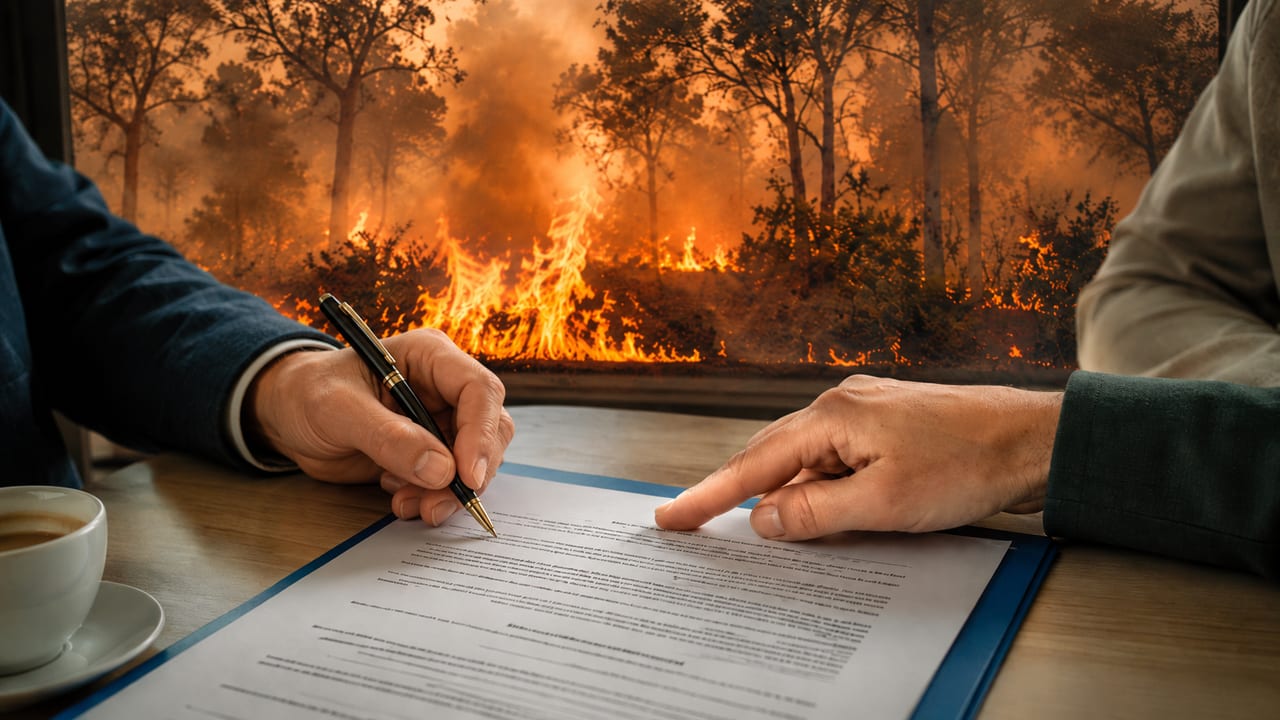

Contrary to popular belief, the forest fires are not covered by the natural disasters scheme in France. Even when caused by natural phenomena such as drought, heatwaves or lightning, these incidents are excluded from this scheme. It is therefore the fire cover under your home insurance policy that will compensate you for damage caused to your home.
Compensation subject to the terms of your contract
The extent of the cover depends on the terms set out in your policy: the amount of cover, excesses, cover for temporary accommodation, and cover for outbuildings and outdoor features. Unlike the natural disaster scheme, where the rules for compensation are standardised and laid down by law, each insurer applies its own terms and conditions. It is therefore essential to check the details of your insurance policy.
What the basic fire cover includes
Included in most contracts, this cover usually includes:
- damage to the property (walls, roof, floors, fixed installations);
- damage caused by smoke or an explosion;
- damage caused by the intervention of the firefighters ;
- certain additional costs, such as clearance, cleaning or temporary rehousing, depending on the terms of the agreement.
Common exclusions you should be aware of
Some policies exclude or limit cover in specific circumstances:
- arson caused by the insured person;
- damage resulting from a clear lack of maintenance;
- gross negligence (to be verified in accordance with the terms);
- fires caused by electrical faults, which are sometimes excluded from lower-end policies.
Reconstruction: will you be properly compensated?
Following a fire, the compensation paid may not be sufficient to rebuild the property exactly as it was. Some policies apply a deduction based on the building’s age and condition. Another pitfall is the property being underinsured. If the home is insured for less than its actual value, the compensation paid out will be insufficient. To minimise these risks, some policyholders opt for cover replacement value or complete reconstruction, although this does increase the contribution.
Additional cover to consider
Depending on your circumstances, there are several options available to enhance your cover:
- the guarantee replacement value, to minimise the impact of the building’s dilapidated condition;
- enhanced cover for household contents, useful for valuable items;
- cover for outbuildings (garage, cellar, garden shed);
- cover for electrical damage to damaged appliances;
- coverage specifically for outdoor fixtures (swimming pools, solar panels, landscaping).
Brush clearing: an obligation that is often overlooked
If your property is situated within 200 metres of a wooded area, you must clear the undergrowth within a 50-metre radius of the dwelling. Failure to comply with this requirement may work against you in the event of a claim, or even reduce the amount of compensation you receive. Please consult the current regulations at our dedicated page.
After a fire: what to do
In the event of a claim, here are the steps to follow:
- report the claim to your insurer as soon as possible;
- take photos of the damage;
- keep your invoices and supporting documents;
- Please do not throw away any damaged items before the assessor has visited.
A rising cost for insurers
Weather-related events are placing an increasing burden on insurers’ balance sheets. In 2025, natural disasters cost €5.2 billion, of which €2.2 billion was linked to hailstorms, according to France Assureurs. This year ranks as the third hottest on record globally and the ninth most costly for French insurers. The cost of repairs rose by 12.3 per cent between the end of 2021 and the end of 2025, with marked increases in joinery (+27.9 per cent) and roof framing, according to INSEE.
Towards a more resilient reconstruction?
A bill, passed at first reading by the National Assembly in April 2026, aims to ban the reconstruction of buildings in their original form in high-risk areas, in favour of buildings that are more resistant to fire, hail or flooding. The bill has yet to be examined by the Senate. In the meantime, the government has announced exceptional measures: the deadline for reporting a claim has been extended to 31 August 2025, and rehousing costs will be covered for three weeks, subject to the terms of the policy taken out. This article is not intended to encourage you to take out additional cover with your insurer or as part of your insurance policy. Take the time to compare premiums, cover, the options on offer and the level of excesses across several insurers.