













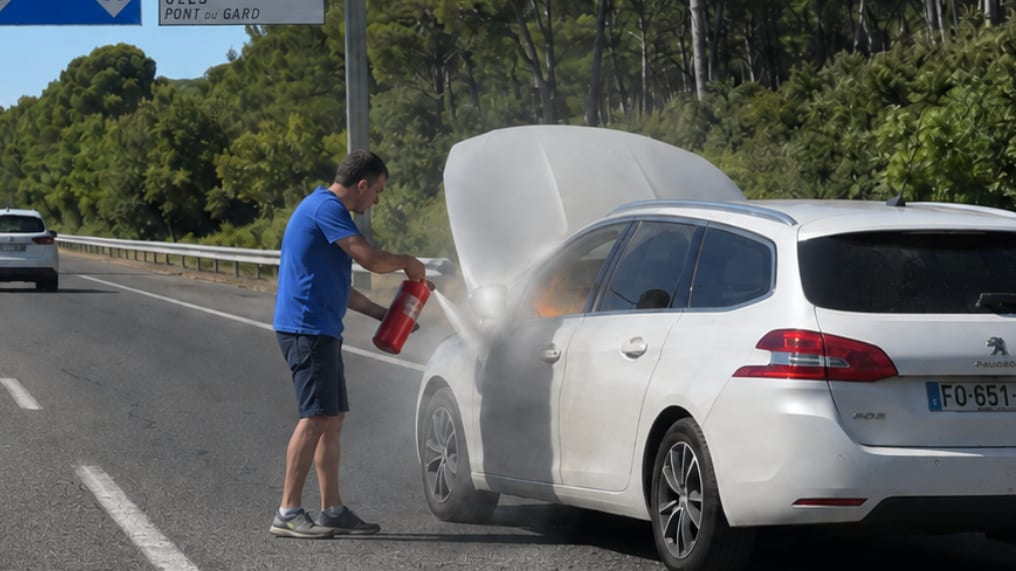

A vehicle fire can break out at any time, whether due to an overheating battery, a short circuit, an accident or even a bush fire at the roadside. Having a fire extinguisher in your car enables you to act quickly to protect passengers, minimise damage to the vehicle and prevent the flames from spreading, particularly during the summer months when the risk of fire is higher.
In France, although this equipment is not compulsory for private individuals, it is strongly recommended, particularly in areas prone to forest fires. Firefighters are regularly called out to fires caused by vehicles, as was recently the case near Biscarrosse in the Landes region, where a burning van ravaged 4,000 hectares of vegetation. Their action in those very first seconds – which is often decisive – helps prevent our forests from going up in flames.
Why should you fit a fire extinguisher to your vehicle?
A car fire extinguisher can be used in a number of situations:
- Extinguish a fire that has just started in the engine compartment, the passenger compartment or the boot.
- To assist with another vehicle in the event of an accident, before the emergency services arrive.
- Bringing a nascent wildfire under control, particularly in dry or forested areas, where a spark or a cigarette butt can set the grass or bushes alight.
In summer, weather conditions encourage fires to spread rapidly. Firefighters are frequently called out to contain fires caused by vehicles, as was the case in Carcassonne recently, when a fire on a motorway required a large-scale operation to prevent a disaster.
Legal obligations in France and Europe
In France, fire extinguishers are not compulsory for private cars, but they are for certain professional vehicles, such as breakdown lorries or heavy goods vehicles weighing over 3.5 tonnes. The situation varies across Europe, however: several countries require this equipment to be carried in all vehicles, with fines or vehicle impoundment as penalties for non-compliance. These include:
- Poland, Greece, Turkey, Estonia, Latvia, Lithuania, Romania, Bulgaria and Bosnia and Herzegovina, where a fire extinguisher is compulsory for all vehicles, including foreign ones.
- In Belgium, it is compulsory only for locally registered vehicles.
Before travelling abroad, it is advisable to check the legislation of your destination country to avoid any inconvenience. Even if it is not compulsory, a compact fire extinguisher can prove invaluable in an emergency.
Which fire extinguisher should you choose for your car?
ABC dry powder fire extinguishers are best suited for vehicles, as they are effective against fires involving solids (Class A), liquids (Class B) and gases (Class C). However, they are not suitable for fires involving electric vehicle batteries: in such cases, you should call the emergency services and move away from the vehicle whilst waiting for them to arrive. A 2 kg extinguisher is recommended for saloon cars, SUVs, people carriers or commercial vehicles. A 1 kg extinguisher is recommended for small cars.
The fire extinguisher must be easily accessible and securely fixed in place to prevent it from becoming a projectile in the event of an impact. It is also important to check its condition, pressure and inspection date regularly.
Liability in the event of a fire caused by a vehicle
A vehicle on fire can cause a forest fire, but the driver is not automatically prosecuted. It is the compulsory third-party liability insurance that compensates victims once liability has been established. Criminal convictions are only handed down if gross negligence is proven, such as a failure to maintain the vehicle, overloading or a breach of safety regulations.
Legal proceedings can be lengthy, as illustrated by the fire at La Teste-de-Buch in July 2022, when a broken-down van sparked a fire that ravaged several thousand hectares. In this case, investigators sought to determine whether the driver had been negligent.
Firefighters, who are often on the front line when it comes to putting out these fires, emphasise the importance of prevention. Their rapid response helps to limit the damage, but everyone’s vigilance remains essential to prevent fires from starting, particularly during periods of fire safety.