













The announcement comes following an unprecedented 2025 season. The Spanish Government has put in place the largest-ever programme of resources and equipment to prevent and combat forest fires, bringing forward the start of the national campaign to 1 June.
‘Fire doesn’t ask for permission, it doesn’t negotiate, it doesn’t wait’, Pedro Sánchez emphasised during his presentation, calling for a major national pact in the face of the climate emergency. According to European data, Spain suffered unprecedented damage last year: more than 400,000 hectares were devastated, accounting for nearly 40 per cent of the European total, making 2025 the worst year on record in the country — surpassing the previous record set in 2022 (253,000 ha).
Airbus’s ‘game-changer’: 20 tonnes of water in under 10 seconds
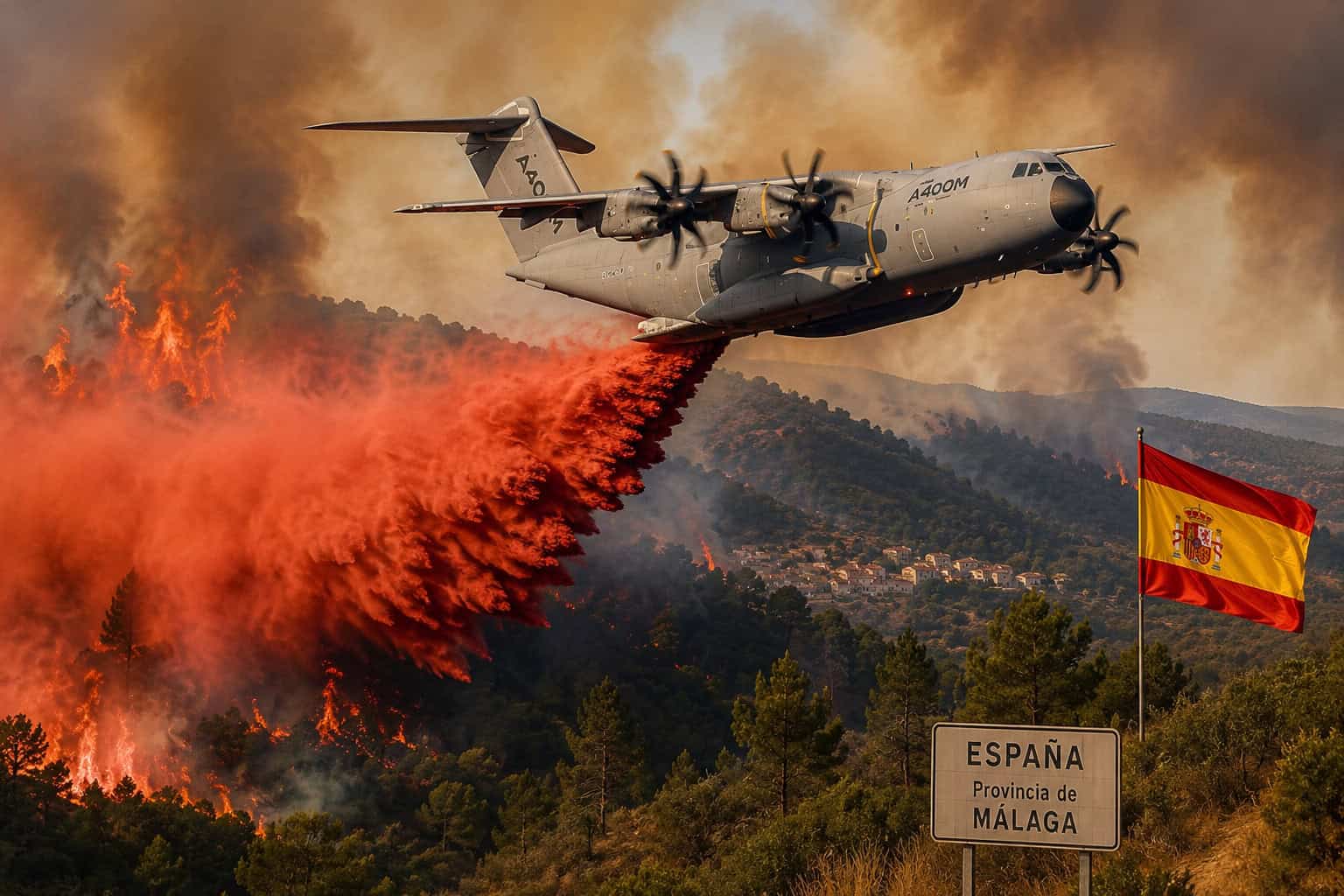
This is the main new feature of the 2026 plan. During the presentation of the 2026 forest fire-fighting campaign at Torrejón de Ardoz Air Base, Pedro Sánchez explained that Spain will have a fleet of 15 amphibious aircraft, the new fire-fighting kit for the Airbus A400Ms, as well as four new Chinook helicopters and two Cougars, which will supplement the resources already in operation with the Emergency Helicopter Battalion.
The module developed by Airbus is based on a removable RORO (roll-on/roll-off) kit installed in the aircraft’s hold. Its technical specifications are impressive:
- Dropping capacity : up to 20,000 litres (20 tonnes) of water or fire retardant
- Duration of the drop : less than 10 seconds
- Operational altitude : 150 feet (45 metres)
- Drop rate : 125 knots (230 km/h)
- System : gravity-fed release, with no added complexity
By way of comparison, a De Havilland Canada CL-415 can drop up to 6,000 litres. The A400M is therefore in a different league. The addition of the A400M to Spain’s fire-fighting fleet will give the country a large water-bombing aircraft capability for the first time.
An added bonus: the kit’s fuel tank can be refuelled on the ground very quickly using standard equipment available at any aerodrome, whether paved or unpaved. This can even be done whilst the engines are running to save time.
An extensive programme of trials prior to commissioning
The operational deployment marks the culmination of four years of development. Airbus had unveiled the concept in July 2022, but the project had initially met with a certain degree of scepticism on the French side. The Directorate-General for Civil Security and Crisis Management (DGSCGC) raised two main concerns: the A400M’s inability to scoop up water at sea or near bodies of water, and doubts about the effectiveness of the water’s blast in extinguishing the flames.
The trials supervised by the Entente-Valabre Test and Research Centre (CEREN) proved successful, however, and Airbus Defence and Space has just completed full-scale in-flight tests of its future forest fire-fighting aircraft, namely a series of retardant drop tests from an A400M aircraft fitted with its fire-fighting kit, carried out at Nîmes-Garons Airport, the Civil Protection base.
In France, the decision has not yet been finalised. During a parliamentary hearing, General Jérôme Bellanger, Chief of Staff of the Air and Space Force, confirmed that the prototype’s performance exceeds that of the Canadair aircraft, whilst highlighting the constraints involved: specialist pilot training, dedicated infrastructure, human resources… all of which are prerequisites that argue in favour of civil aviation safety remaining responsible for this mission. Spain, where civil aviation safety missions are already carried out by the Ejército del Aire y del Espacio via its 43rd Group, does not face this organisational obstacle.
A strengthened overall capability: aeroplanes, helicopters and drones
As well as the A400Ms, Spain is bolstering its entire aerial fire-fighting fleet:
- 43rd Air Group : up to 10 aircraft deployed across eight secondary bases, in addition to its main base at Torrejón. Outside of operations, it will keep two aircraft on permanent standby, capable of responding within less than an hour. The fleet currently consists of Canadair CL-215T and Bombardier CL-415.
- Modernisation in progress : the planned acquisition of seven new DHC-515 aircraft as part of the Defence Industrial and Technological Plan.
- FAMET (Army Airborne Forces) : 4 CH-47F Chinook helicopters and 2 Cougars. The Chinooks can now carry a flexible bucket (Bambi Bucket) capable of holding up to 7,000 litres of water — a capability that did not exist in 2025.
- Additional resources : new high-capacity drones, all-terrain vehicles, thermal cameras and advanced surveillance and tracking systems.
One question remains unanswered
Whilst the political announcement is clear, several grey areas remain. Sánchez did not specify how many A400Ms would be fitted with the system, nor the exact operational doctrine for these aircraft — whether they would be used for supplementary operations in the event of a major wildfire, provide support outside the peak season, or be permanently integrated into the system. The Spanish Air and Space Force has 14 A400Ms, which leaves considerable theoretical scope for manoeuvre. As for France, which has 24, the decision on whether to follow suit remains pending.