











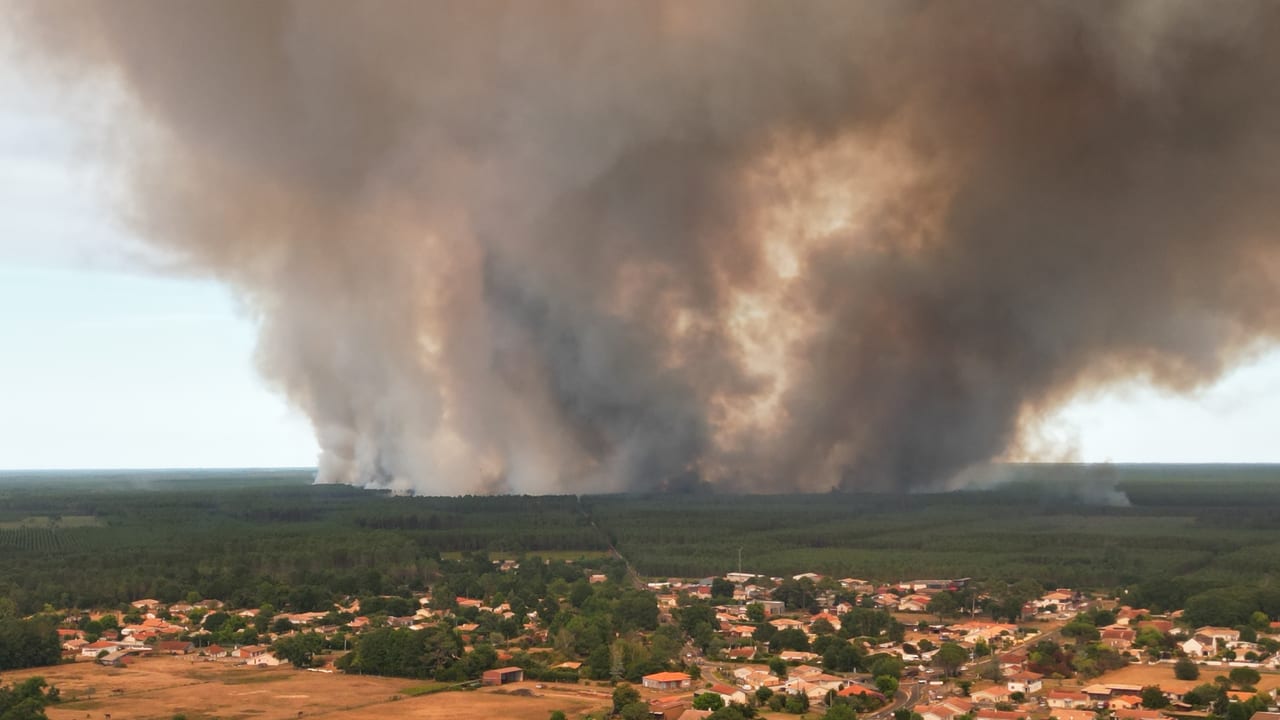

The fire that ravaged the Gironde On 22 July 2026, one of the summer’s biggest events in France was officially declared to have come to an end. It began in the town of Saumos, north-west of Bordeaux and near the Arcachon Bay, the fire spread rapidly, fuelled by extremely dry vegetation and strong winds, covering a total area of 42,000 hectares.
The municipalities of Le Porge, Lège-Cap-Ferret, Sainte-Hélène, Salaunes, Saint-Médard-en-Jalles, Saint-Aubin-de-Médoc, Martignas-sur-Jalle, Saint-Jean-d’Illac, Cestas, Marcheprime and Mios were particularly at risk. Given the scale of the crisis, more than 220,000 people were evacuated as a precautionary measure across 24 municipalities, particularly around the Arcachon basin and in the western part of the Bordeaux metropolitan area. The alerts FR-Alert were mobilised to organise some of these evacuations.
An unprecedented mobilisation of emergency services
At the height of the operation, nearly 3,300 firefighters were deployed, supported by 24 aircraft, 1,500 military personnel and 1,250 members of the internal security forces. Their efforts brought the fire under control by the end of July, allowing residents to gradually return to their homes and the A63 motorway to be reopened.
The fire service has, however, paid a heavy price: 231 of its members have been injured since the start of the incident. The damage to property is also significant, with 240 homes destroyed. The weeks following the stabilisation of the fire were spent monitoring the fire’s edges and extinguishing the numerous hotspots, some of which were underground and could smoulder for weeks.
The handling of this crisis has highlighted the coordination between the various emergency services, as well as the importance of aerial resources in combating mega-fires. Local authorities and residents have praised the commitment of the firefighters, whose efforts helped prevent an even greater disaster.